B1342 Transistor Pinout, Features, Applications, Equivalents, and More
B1342 is a PNP Darlington transistor available in a TO-220Fa package. The transistor is designed for power amp applications. In this post we will understand B1342 transistor pinout, features, applications, equivalents, advantages and disadvantages of this device.
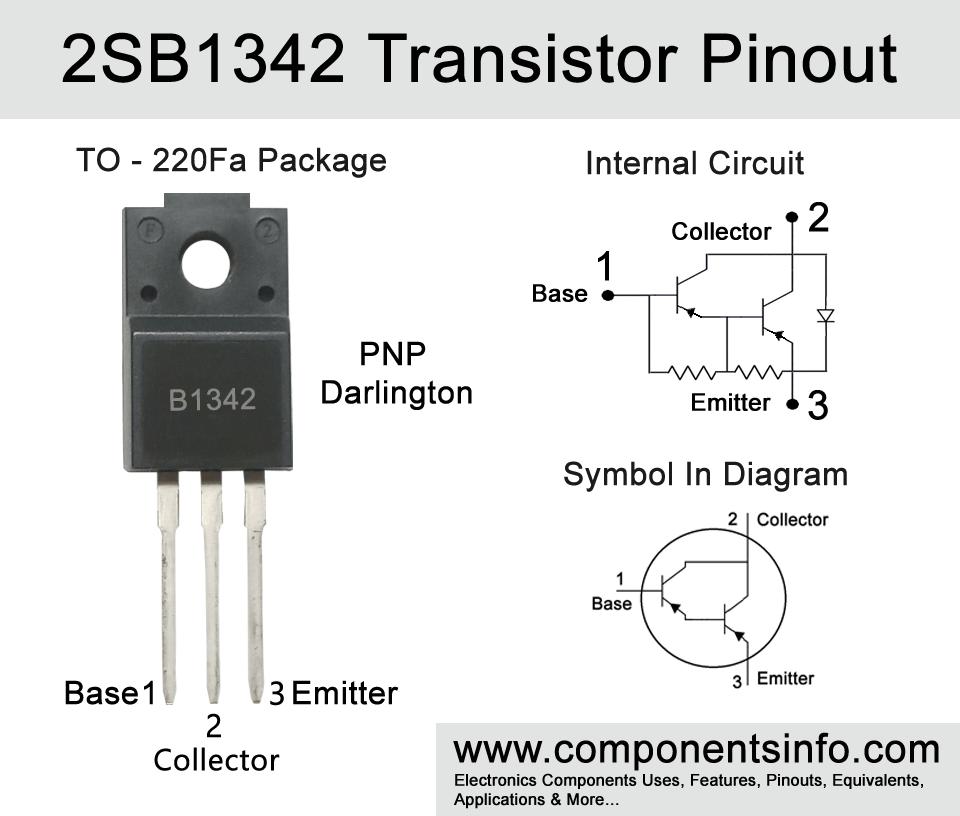
Pin Configuration:
The pin configuration of the transistor are as follows:
Pin1 is the Base pin: With the help of the base pin we can control the flow of current from Emitter to Collector.
Pins2 is the Collector pin: The collector pin drives the output of the transistor.
Pin3 is the Emitter pin:
The current first enters the transistor from the Emitter pin and then through the base pin it goes to the collector pin.
Understanding the B1342 Transistor:
B1342 is a PNP Darlington Transistor designed for power amp applications. As it is a Darlington transistor it means it contains two PNP bipolar junction transistors inside which are connected in a special way that increases the output gain to a great extent, connecting transistors in this way is called Darlington.
The transistor has some good features such as very high DC current gain of maximum 10,000, collector base voltage (VCBO) of 80V, Maximum saturation voltage is only -1.5V, and transition frequency of 12MHz.
As discussed that it is designed for audio power amp applications but it is not limited to these applications and can also be used in other applications such as LED driver, motor driver, switching, relay controller etc.
NPN Complementary:
NPN complimentary of 2SB1342 is 2SD1933.
Features and Specifications of the Transistor:
- Package Type: TO-220Fa
- Transistor Type: PNP Darlington
- Max Collector Current(IC): –4A
- Max Collector-Emitter Voltage (VCEO): –80V
- Max Collector-Base Voltage (VCBO): –80V
- Max Emitter-Base Voltage (VEBO): –7V
- Max Collector Power Dissipation (Pc): 30W
- Minimum to Maximum DC Current Gain (hFE): 1000 to 10,000
- Max Storage & Operating temperature: -55 to +150 Centigrade
NPN Complimentary
NPN complimentary of 2SB1342 is 2SD1933.
Replacement & Equivalent
2SB1344, 2SB1343, 2SB1087, 2SB1087, 2SB1021, 2SB1252, 2SB1020 2SB1252, 2SB1107, 2SB955.
Advantages & Disadvantages of Using B1342:
Here are the advantages and disadvantages of B1342 Darlington transistor:
Advantages:
A High Voltage Transistor: The maximum collector-emitter voltage is up to -80V which is ideal for high voltage applications.
Collector Current of -4A: With -4A collector current this transistor will work perfectly for power amps and driver applications.
Saturation Voltage of Only -1.5V: The low saturation voltage increases the efficiency of the transistor by reducing the voltage drop in ON state.
Maximum DC Current Gain of Up to 10,000: That much DC current makes the transistor capable of driving loads on very low or small base current.
Complementary Transistor Available: The complementary pair of the transistor is also available which is another advantage and can be used with it for better performance.
Power Dissipation of Up to 30 Watts: High power dissipation helps the transistor to handle power applications. Moreover, adding a suitable heatsink can also further improve this performance.
Disadvantages:
Only -4A Collector Current: -4A collector current is acceptable for low power applications but if your load has high current you have to look for another option.
Slow Switching Speed: Darlington transistors are not good at high speed switching so you cannot use them in high speed switching.
Not Suitable For Low Voltage Circuits: Darlingtons have high base-emitter voltage therefore they don’t work well in low voltage applications.
Power Loss Problem: Darlingtons have more saturation losses than a normal BJT transistor due to which they are not very energy efficient for battery operated applications.
Applications:
Audio Amplifiers
Motor Driver Circuits
Power Driver Circuits
Signal Amplification
Power Supply Circuits
Switching Applications
Control Systems
Conclusion:
2SB1342 is a PNP Darlington transistor available in TO-220Fa package. The transistor is designed for power amps applications. The maximum collector current is -4A, maximum collector-emitter voltage is -80V, maximum base current is also -80V, maximum emitter-base voltage is -7V, maximum collector power dissipation is 30W. The transistor has many good features such as low saturation voltage of only -1.5V, good collector current, DC current gain of up to 10,000 and availability of its NPN complementary transistor but the transistor also has some disadvantages which make it not ideal for some applications such as collector current is acceptable for low to medium power applications but not for high power applications, As it is a Darlington transistor so it has low switching speed which makes it unsuitable for high speed switching applications, it is not good for low voltage circuits, Darlington transistors have more saturation losses as compared to a normal BJT however with all these limitations this transistor can still be a good choice for variety of applications.
Datasheet:
To download the datasheet just copy and paste the below link in your browser.
https://www.alldatasheet.com/datasheet-pdf/view/438415/ISC/2SB1342.html