BC373 Transistor Pinout, Features, Equivalents, Applications, Advantages and More
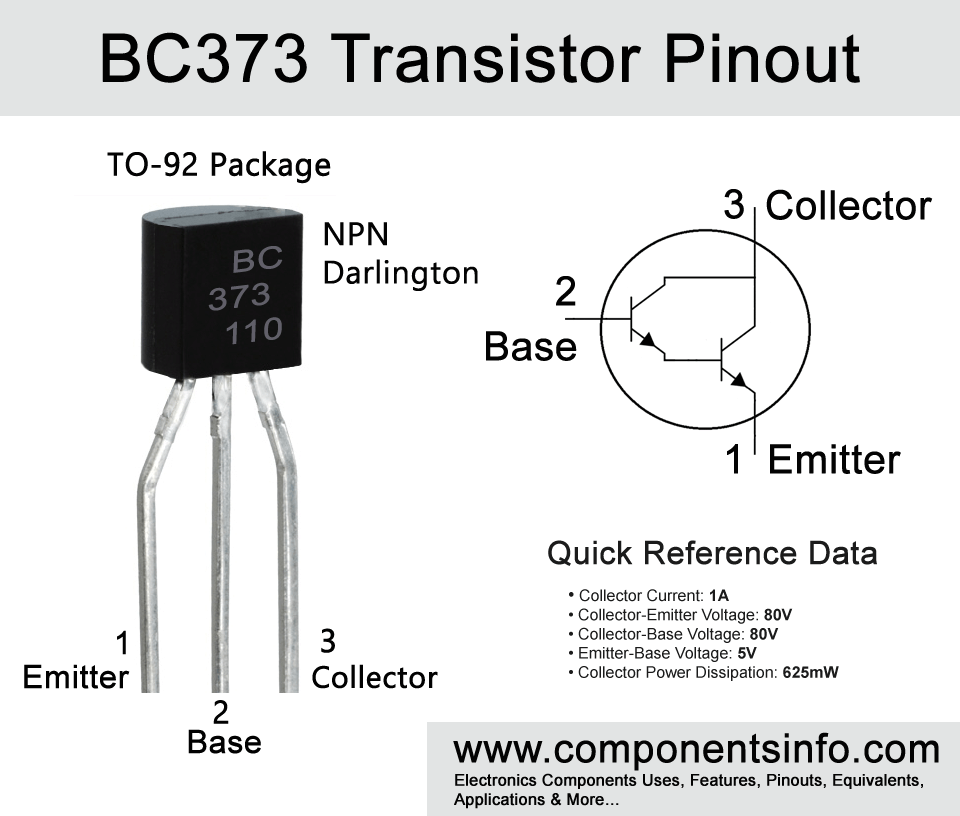
BC373 is an NPN Darlington transistor available in a TO-92 package. In this post we will understand BC373 transistor pinout, features, equivalents, applications, advantages, and more.
Understanding the BC373 Transistor:
BC373 is an NPN darlington transistor. A Darlington transistor is a transistor that contains two transistors inside a single package. These two transistors are connected in a special way which increases the output current gain to a great extent meaning we can control a large amount of output collector current with very low base current.
The package of the Darlington transistors are same as a normal BJT three pin transistor and one cannot understand by looking at the package only that it is a Darlington transistor or a normal transistor. Each transistor inside of a Darlington transistor contains three layers which are N-type / P-type / N-type. The first pin is the Emitter which is an N-type region and it is heavily doped which means in this region there are large number of electrons ready to move to the base region. The second or middle is the Base pin, which is a thin p-type region through which we can control how much electrons should flow from the Emitter to the Collector by applying a very small amount of current to this base pin. The Collector of the transistor is lightly doped and it is also an N-type region. The next pin Collector (Also N-type) is lightly doped. The purpose of this pin is to collector electrons coming from the Emitter through the Base and then send them to the external circuitry.
Moreover the transistor also have has some good features, which are collector to emitter voltage, upto 200MHz transition frequency, a good collector current of upto 1A and noise figure of typically 2.0dB.
Pin Configuration:
The pin configuration of the transistor are as follows:
Pin1 is the Emitter pin:
Pin1 is the Emitter pin of the transistor and it is heavily doped. The electrons more from the Emitter to the Collector through the Base but the current moves from Collector to Emitter through the base.
Pin2 is the Base pin: As discussed above the base pin is the middle pin, through the base pin we can control the flow of current by providing a little current to the base due to which we can control a large output collector current.
Pins3 is the Collector pin: The Pin3 is the Collector pin, and it is lightly doped. The load is derived from the Collector pin.
Replacement & Equivalent
BC372, 2SD1978.
Advantages & Disadvantages of Using BC373:
Here we are pointing out the advantages and disadvantages of choosing BC373 for your circuits or applications.
Advantages:
BC373 is a high gain NPN Darlington transistor available in TO-92 package. It is a high voltage transistor of upto 80V. As it is a Darlington transistor, it provides very high gain and can drive loads with minimum base current. It is also a low noise transistor with an approximate noise figure of 2dB.But on the other hand it also has some cons:
A High Gain Transistor: As discussed above, it is a Darlington transistor so it contains two transistors inside connected in a Darlington way, which increases gain to a great extent, and as a result, it can control large loads with minimum base current.
Low Noise Capability: The transistor also has low noise capability of approx. 2dB, which reduces distortion in a signal. This capability improves the output performance in the application where low noise is important, for example, in audio amplifier circuits.
High Voltage Handling Capability: The transistor can handle up to 80V, which makes it ideal to use in switching circuits that requires under 80V. Moreover, this feature makes it ideal to use in industrial applications.
Small Package: The small TO-92 package is an ideal transistor package for portable devices because it requires little space on PCB.
Low Drive Requirements: As mentioned before, Darlington transistors require very low base current, which makes them ideal to use directly at the output of logic ICs and Microcontrollers, and you do not require to use an extra driver stage.
Disadvantages:
Limited Collector Current: The maximum collector current of the transistor is only 1A. Although it is good if you want to drive small loads but we cannot drive loads above 1A with this transistor, for example high, current motors and other high current loads.
High Collector-Emitter Saturation Voltage: The approx. collector to emitter saturation voltage is 1V or higher. This is a little bit more than a normal transistor. This disadvantage causes this transistor to consume a little more power and makes it unsuitable for portable or battery operated applications.
A Darlington Transistor has Slow Switching Speed: As it is a Darlington transistor and there are two transistors inside. The combination of these transistors increase the gain very much but the disadvantage of this combination is that it slows the switching speed. So you can only use it in circuits in which you require a normal switching and cannot use it in applications that require fast switching speed.
High Base-Emitter Voltage: As it is a Darlingtor transistor, it has high base-emitter voltage of 1.4 to 2V. Therefore, it is not suitable for low voltage circuits because it will require 1.4 to 2V to fully turn ON.
BC373 Applications:
Driving Microcontroller Output
Audio Preamplifiers
Signal Amplification
Audio Amplifiers
Low Noise Audio Amplification
Relay Driver
Many General Purpose Applications
Conclusion:
BC373 is a high gain NPN Darlington transistor available in a TO-92 package. It is a high voltage transistor with a rating of upto 80V. As it is a Darlington transistor, it provides very high gain and can drive loads with minimum base current. It is also a low noise transistor with an approximate noise figure of 2dB.
On the other hand, it also has some disadvantages. It has limited collector current of only 1A. It also has high collector to emitter saturation voltage, low switching speed and high base to emitter voltage.
Overall, this transistor is suitable for the applications in which high current gain and high voltage (under 80V) are required where there is no special requirements for high efficiency and switching speed.
Datasheet:
To download the datasheet just copy and paste the below link in your browser.
https://www.alldatasheet.com/datasheet-pdf/view/182337/ONSEMI/BC373.html